Inside Paramount Peak: how a 13-brand Super Bowl takeover came together
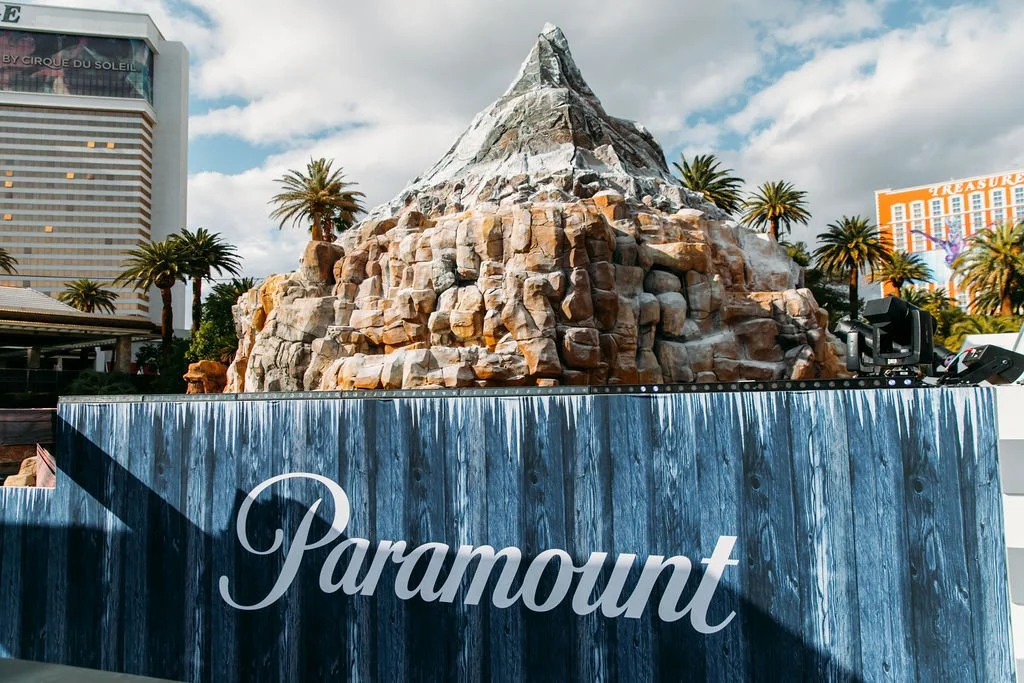
Super Bowl week is the most crowded week on the brand activation calendar. Networks, sponsors and consumer brands all arrive in the host city at the same time, and they all want the same outcome: to be the brand people are still talking about on Monday. For Super Bowl LVIII in Las Vegas, Paramount asked us to make it the most talked-about brand in entertainment. Our answer was Paramount Peak, a 75-foot, 45,000-pound mountain at the center of a 36,000-square-foot experience that ran for four days and was seven months in the making.
This post walks through how that project was structured and what we would tell any brand planning a tentpole moment, whether it is a Super Bowl, a festival weekend or an awards-season takeover. It is written from the point of view of the experiential marketing agency that built it. The full case study, with photos and stats, is on our Paramount at Super Bowl LVIII page.
The brief: 13 brands under one mountain
Paramount came to Las Vegas with a problem many multi-brand companies will recognize. It was the first time after the merger that its biggest brands would appear together in one place. The brief had two halves that pull against each other. Each brand in the family needed its own moment, with its own fans and its own identity intact. At the same time, the whole experience had to read as one Paramount, so that superfans, press, executives and talent all left with the same impression of the parent company.
The organizing idea was a celebration of Paramount’s “Mountain of Entertainment.” That gave us a single physical object big enough to hold 13 dedicated IP activations without any one of them feeling like an add-on. A shared architecture is the most direct way to solve the family-of-brands problem. If every activation lives on the same mountain, they belong together by default, and each one is still free to look like itself.
This is a decision we would make again on any multi-brand brief. When the parent brand and the individual brands both need credit, give them a shared structure first and individual rooms second. Guests experience the structure as the event and the rooms as the reasons to explore it.
The campaign started 100 days out
The mountain came at the end of the campaign. The work began 100 days before the game across social, digital, TV and OOH, and built toward an in-person takeover of the host city. That sequencing matters. By the time guests reached Paramount Peak, the idea had been in front of them for more than three months, and the physical experience paid off something they already recognized.
For any tentpole, we push clients to decide early whether the live experience is the whole campaign or its finale. When it is the finale, every earlier touchpoint should point toward it: the same visual language, the same name, and a reason to show up in person that a phone can’t deliver. When it is the whole campaign, the experience has to generate its own awareness on site, which usually means a bigger footprint on the street and a larger share of budget for press and creators.
What was on the mountain
Paramount Peak ran a full city block. Inside the 36,000-square-foot footprint:
- 13 dedicated IP activations, one for each brand in the family
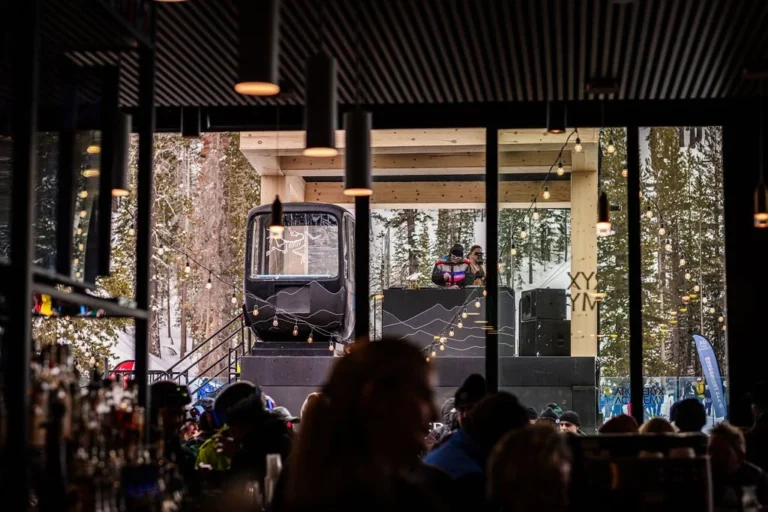
- Five 4DX gondola experiences with 270-degree digital windows, which turned the ride up the mountain into entertainment of its own
- Two exclusive VIP events alongside the public program
- More than 2,000 guests a day, with thousands moving through the space daily over the four-day run
Paramount’s presence did not stop at the Peak. CBS Sports had its own installations at the Bellagio, a gold football and pillar art placed in the hotel’s alcoves, and the site hosted live broadcasts during the week. Putting the brand into a second high-traffic location meant Paramount showed up where Super Bowl visitors already were, as well as at a destination they had to choose to visit.
Seven months for four days
Seven months of lead time for a four-day run sounds lopsided until you list what a build of this weight involves. A 45,000-pound structure has to be engineered, fabricated, transported and assembled inside a fixed load-in window, then struck on an equally tight schedule. The gondolas add another layer: ride hardware, synchronized media for the digital windows, and operating procedures for moving guests through at a steady pace.
When we plan anything at this scale, the schedule is worked backward from doors open. Load-in and strike windows come first, because host-city venues and streets are committed early during Super Bowl week and nothing moves once the week starts. Fabrication sits behind that, engineering behind fabrication, and design approval behind engineering. Creative decisions that arrive late are the most expensive ones, because they ripple through every step that follows. With 13 brands involved, keeping approvals in order was as much a production task as anything built in a shop.
Six lessons for tentpole activations
1. Give the audience one thing to remember
Tentpole weeks are loud. Event Marketer counted 16 notable activations at Super Bowl LX in San Francisco this February, from a Bud Light and Post Malone concert at Fort Mason to Marriott Bonvoy House at The San Francisco Mint. In that company, a list of features is easy to forget. A 75-foot mountain is not. Before you design the rooms, decide on the single image people will describe to a friend.
2. Design separate journeys inside one world
Paramount Peak served superfans, press, executives and talent, and each group wanted something different. Fans wanted to step inside the shows they love. Press needed access and a clean shot. Executives and talent needed hosted time away from the public flow, which is what the two VIP events were for. Planning those journeys inside the same environment, with their own timing and access, keeps everyone in the same brand world without everyone sharing the same line.
3. Make the movement part of the show
The gondolas turned the act of moving through the space into entertainment. That principle applies anywhere guests have to queue or travel between zones. Dead time is where attention leaks out of an activation. If guests have to get from one point to another, give them something to watch, hear or do on the way.
4. Count capacity before you count square feet
More than 2,000 guests a day across 13 activations is a throughput question first. Every activation has a dwell time, and the sum of those dwell times has to fit inside opening hours at the attendance you expect. Rides with a fixed cycle time, like gondolas, set a hard ceiling on how many people can experience them per hour. Do that math early, then size the build and the staffing to match.
5. Plan for broadcast and content from day one
Live broadcasts from the site and the CBS Sports installations at the Bellagio carried the experience to people who were never going to stand on the mountain. When broadcast is part of the plan, the build has to account for camera positions, power and sightlines that work on screen as well as in person. We cover more of that thinking on our brand activation agency page.
6. Tie the production calendar to the host city’s calendar
Host cities do not get easier. Los Angeles hosts Super Bowl LXI at SoFi Stadium on February 14, 2027, with Super Bowl week events spread across the region, and the host committee notes that the region is hosting the World Cup, the Super Bowl and the Olympics in three consecutive years. Venues, crews, hotel rooms and permits in a host city get committed months ahead. Brands that begin planning in the fall are choosing from what is left.
Why the scale made sense
Sports was the largest U.S. sponsorship category in 2025, at $16.98 billion, according to PQ Media’s 2026-2030 experiential forecast, which also reports U.S. experiential spend pacing 11.8% growth in 2026. The money goes there because the audience is there, in one city, for one week. The risk is spending it on something nobody remembers by Tuesday.
Paramount Peak earned an Honorable Mention for Chief Marketer’s Campaign of the Year, and the Paramount and CBS “Mountain Village” was cited when BizBash gave Cara Kleinhaut its Lifetime Achievement Award in December 2025. Those are good outcomes. The more useful takeaway is the structure behind them: one idea big enough to hold 13 brands, a campaign that built toward it for 100 days, and a production schedule that started seven months before the doors opened.
If you are planning around a tentpole moment in 2027, including Super Bowl LXI, our Los Angeles team is a good place to start. You can also browse more large-scale work on our work page or get in touch directly.